Six Hours a Day, Less Grey Matter: What Screen Time Is Doing to Adult Brains

Christian Dominique
Six Hours a Day, Less Grey Matter: What Screen Time Is Doing to Adult Brains
A growing body of research links heavy screen use to reduced brain volume, weakened memory, and slower processing speed. The effects aren't limited to children.
By AWE Digital Wellness | February 2nd, 2026
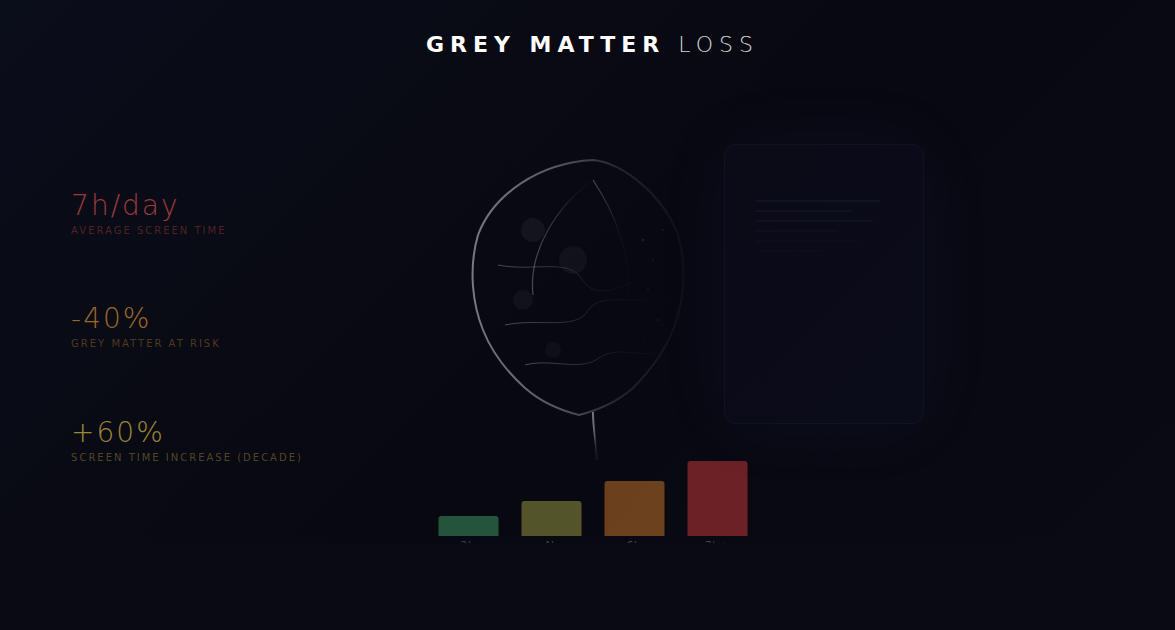
The average American adult spends about seven hours a day on digital devices. That number has climbed by over 60% in the past decade, and it doesn't show signs of leveling off. Remote work, streaming, social media, and now AI chatbots have all contributed to the increase. Most of it feels normal. Some of it is unavoidable.
But the brain keeps score.
A meta-analysis examining screen time and brain structure found that adults spending six or more hours a day on screens showed decreased grey matter volume. Grey matter accounts for about 40% of the brain and handles information processing, sensory perception, voluntary movement, learning, and speech. The same study found reductions in white matter, which manages communication between brain regions. The researchers also identified associations with lower IQ scores and increased risk of cognitive impairment.
These aren't findings about children. These are findings about adults.
And IQ scores are normally relatively stable across the lifespan... unless there is brain damage.
The "Use It or Lose It" Principle
Neuroscientists refer to neuroplasticity, the brain's ability to physically reshape itself based on how it is used. Circuits that are exercised regularly become stronger. Circuits that remain inactive deteriorate.
A 2024 study from the University of Sharjah found that heavy smartphone users among young adults (ages 21–32) showed compromised attention and lower calculation ability. Researchers linked this directly to the neuroplasticity principle. When devices perform tasks such as arithmetic, navigation, spelling, or recall, the neural circuits responsible for those functions weaken through disuse.
Dr. Manfred Spitzer, a German neuroscientist, coined the term "digital dementia" to describe this phenomenon: cognitive decline resulting from excessive reliance on digital devices. While the term is intentionally provocative, the mechanism is well-supported by research.
This aligns with MIT Media Lab’s 2025 research on cognitive debt, which used EEG data to show that individuals relying on AI tools like ChatGPT for writing exhibited weaker neural connectivity compared to those working independently.
The pattern is consistent: outsourcing cognitive effort comes with a biological cost.
Active vs. Passive: Why Type Matters
Not all screen use affects the brain equally.
A 2025 scoping review from Penn State, published in Digital Health, identified a clear distinction among adults over 40.
Active use, involving engagement, decision-making, or skill application (writing, coding, interactive learning), was associated with better cognitive outcomes. Memory, executive function, and attention were preserved or improved.
Passive use, involving consumption without engagement (scrolling, watching without intention, reading without retention), was associated with poorer outcomes. Verbal memory declined, global cognition scores dropped, and processing speed slowed.
This distinction is critical because most recreational screen time is passive: social media scrolling, autoplay video feeds, and content optimized for engagement rather than comprehension.
A dose-response meta-analysis published in PLOS One (2025) found that cognitive performance begins to decline at four to six hours of television viewing per day. Researchers suggest that passive digital consumption follows a similar pattern.
The Sleep Connection
Screen use impacts more than waking cognition—it disrupts the systems that support brain recovery during sleep.
Studies consistently show that device use before bedtime reduces melatonin production, lowers sleep quality, and shortens sleep duration. Sleep is essential for memory consolidation, metabolic waste clearance, and restoring attention capacity.
A randomized controlled trial found that adults who reduced smartphone use to under two hours per day experienced measurable improvements in mood, stress, and focus within three weeks.
What This Means for Professionals
For knowledge workers, seven hours of daily screen time is common. Much of this time is passive: scanning emails, browsing messages, or scrolling social media.
None of it feels harmful in the moment—that's part of the issue.
The brain does not signal declining grey matter or slowing processing speed in real time. Effects accumulate gradually, eventually showing up as reduced concentration, forgetfulness, and slower problem-solving.
For organizations, this becomes a performance issue. Teams heavily engaged in passive screen use will think differently—and less effectively—than those engaged in active work.
Building a Screen Diet That Works
The research does not suggest eliminating screens, but optimizing how they are used.
Track active vs passive usage
Most people are unaware of how their screen time is distributed.Protect pre-sleep time
A 30–60 minute screen-free window before bed supports cognitive recovery.Shift toward active engagement
Replace passive consumption with activities that require thinking.Take real breaks
Switching screens is not rest. Stepping away entirely is.
The Bigger Picture
The concept of "digital dementia" is intentionally alarming, but the underlying message is clear: the brain adapts to how it is used.
A 2025 meta-analysis in Nature Human Behaviour suggests that technology use can be beneficial when active, but harmful when passive.
The issue is not screen use itself, but how that time is invested.
Seven hours a day represents a significant portion of cognitive capacity. The real question is how to use it wisely.
References
Shaleha, R. & Roque, N. (2025). From screens to cognition. Digital Health.
Benge, J. F. & Scullin, M. K. (2025). Technology use and cognitive aging. Nature Human Behaviour.
Shalash, R. J. & Arumugam, A. (2024). Night screen time and cognition. Journal of Multidisciplinary Healthcare.
PLOS One. (2025). TV viewing and cognitive outcomes.
Mark, G. (2023). Attention Span.