79 Countries and Counting: The Global Movement to Ban Phones in Schools

Christian Dominique
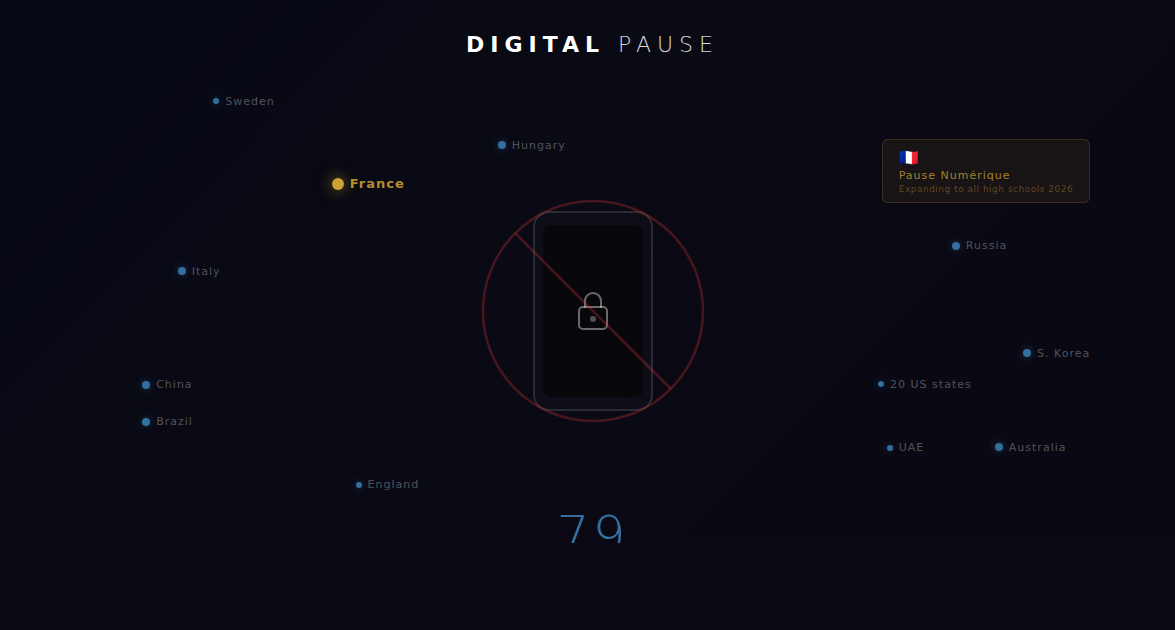
79 Countries and Counting: The Global Movement to Ban Phones in Schools
From France's "digital pause" to nationwide bans in Italy, Hungary, and Australia, governments are pulling phones out of classrooms. Here's what's driving the wave and what the evidence says.
By AWE Digital Wellness | January 19th, 2026
In November 2025, French President Emmanuel Macron stood in front of the press and announced that France would extend its mobile phone ban to all high schools (lycées) starting in the 2026–2027 school year. Students aged 15 to 18 would be required to hand in their phones at the school gate.
France had already been moving in this direction. The country first restricted phones in primary and middle schools in 2018, but enforcement remained inconsistent. Students technically had to keep phones off, but many simply kept them in pockets with notifications silent. The rule existed more on paper than in practice.
This changed in September 2024, when France launched a nationwide pilot called the pause numérique across 200 middle schools. The difference this time: students physically surrendered their phones on arrival. Lockers, pouches, collection points at the entrance. No phone in your hands for the entire school day.
The results from the pilot, according to Education Minister Elisabeth Borne, were "very positive, particularly in terms of improving the school climate." By early 2025, the program rolled out to all middle schools in France. By late 2025, Macron was pushing to extend it further.
Why France Matters
France didn't invent the school phone ban. Italy restricted classroom phone use as early as 2007. China implemented restrictions in 2021. Several US states have passed legislation in recent years. Quebec province in Canada introduced phone-free schools in September 2025.
France's approach stands out for three reasons.
First, scope. This is a nationwide, government-backed mandate with funding attached. The French government allocated resources for schools to install lockers and purchase storage pouches, with costs estimated around €130 million for all middle schools.
Second, enforcement. France recognized that telling students to "turn off your phone" doesn't work. The pause numérique requires physical separation. Phones are placed in lockers or pouches at the start of the day and returned at the end.
Third, escalation. France is one of the only countries expanding restrictions to older students, acknowledging that attention and developmental concerns do not disappear in high school.
The Global Map
France is part of a broader global movement that has accelerated in recent years. According to UNESCO, 79 education systems worldwide had implemented smartphone bans or restrictions by the end of 2024, up from 60 in 2023 — a 32% increase in one year.
Total bans (phones not allowed or confiscated)
Algeria, Australia (New South Wales, South Australia), Bulgaria, China, Hungary, Italy, Kuwait, Russia, Rwanda, UAE.
Bell-to-bell bans (phones locked away for the full school day)
France, South Korea (2025), Brazil (federal law passed January 2025 for ages 4–17), and US states including California, Florida, Indiana, and Ohio.
Partial restrictions (classroom use banned, breaks allowed)
England, Sweden, Ireland, Spain (regional), Japan, Germany.
Hungary's approach requires students to hand over smartphones on arrival and retrieve them at departure. Reports indicate fewer classroom disruptions and improved behavior.
South Korea passed a nationwide law in 2025 banning phone use in classrooms. Brazil implemented a federal law restricting phone use for students aged 4 to 17.
What the Research Says
The evidence on phone bans is mixed.
A study from Birmingham University found no proof that banning phones alone improves academic performance or mental wellbeing. Researchers suggested that bans must be combined with broader strategies, including reducing phone use outside school.
Research cited in UNESCO's 2023 Global Education Monitoring Report found that removing smartphones in Belgium, Spain, and the UK improved learning outcomes, especially for lower-performing students. Teachers reported calmer classrooms, increased face-to-face interaction, and reduced cyberbullying.
OECD PISA data shows that students who frequently used phones during math class scored 25 points lower on average, equivalent to more than half a year of lost learning.
Long-term effects remain unclear. It is uncertain whether bans create lasting behavioral change or simply shift phone usage outside school hours.
Observations from Quebec suggest that students may compensate with increased nighttime phone use, often staying up late and experiencing fatigue. This indicates the issue may be displaced rather than resolved.
The Bigger Debate
Critics of phone bans raise valid concerns.
- Parents worry about emergency communication.
- Students with medical needs rely on certain applications.
- Some educators argue that bans avoid teaching digital literacy and self-regulation.
These concerns can be addressed through:
- school communication systems
- medical exceptions
- integrated digital education
A deeper issue is cultural. Phones have become extensions of identity, particularly for young people.
France addressed this by framing the policy as a digital pause rather than a ban. This framing emphasizes restoration rather than restriction.
What This Means for Digital Wellness
The school phone ban movement signals a shift from awareness to action in digital wellbeing.
The same issues observed in schools — fragmented attention, reduced cognitive engagement, and decreased face-to-face interaction — are present in workplaces and everyday life.
If children struggle with constant digital stimulation during learning, it raises important questions about adult environments.
France's expansion to high schools will be a key case study influencing future policy decisions.
Conclusion: Toward Intentional Digital Use
School phone bans reflect a growing recognition of the need for balance in technology use.
The objective is not to eliminate technology, but to use it intentionally.
A digital pause — whether in schools, workplaces, or homes — may support improved focus, healthier habits, and stronger human connections.
References
UNESCO. (2025). Smartphones in school: Only when they clearly support learning.
Macron, E. (2025, November). Press conference on screen addiction and school phone policy.
Borne, E. (2025). Senate Q&A session on mobile phone ban expansion.
France24. (2024). Digital pause: France pilots school mobile phone ban.
Euronews. (2024). Smartphone restrictions in European schools.
OECD/PISA. (2023). Students, Computers and Learning: Making the Connection.