The Hidden Cost of AI Convenience: What MIT's Brain Study Means for Workplace Productivity and Education Sovereignty

Christian Dominique
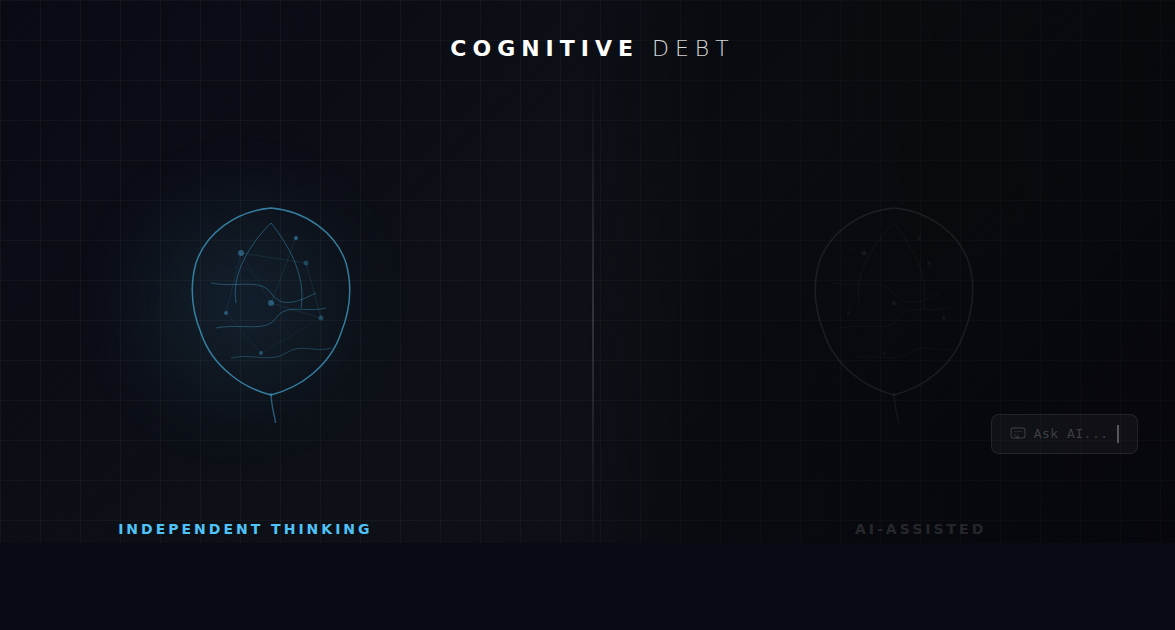
The Hidden Cost of AI Convenience: What MIT's Brain Study Means for Workplace Productivity and Education Sovereignty
New research shows that AI writing tools reduce brain connectivity and weaken cognitive ownership. Here's what that means for your team.
By AWE Digital Wellness | January 5th, 2026
Everyone on your team is probably using ChatGPT. For emails, first drafts, summaries they don’t feel like writing from scratch. It saves time. Nobody disputes that.
But a study from MIT’s Media Lab, published in June 2025, quantifies something many people have only sensed: the more you let AI do the thinking, the less your brain engages. And that disengagement compounds over time.
What the Researchers Actually Did
Lead researcher Nataliya Kosmyna and her team recruited 54 participants from five universities. They were split into three groups:
- one used ChatGPT
- one used a search engine
- one used no tools
Each participant completed writing tasks over four months.
In a fourth session, the conditions were reversed.
Researchers monitored brain activity using EEG, measuring communication between brain regions during writing.
The Results Were Not Subtle
Brain connectivity decreased in proportion to the level of assistance.
- Independent writers showed the strongest neural activity
- Search users were intermediate
- ChatGPT users showed the weakest connectivity
When ChatGPT users were later asked to write without assistance, their brains showed reduced engagement. Meanwhile, independent writers adapted easily when given AI tools.
The conclusion is clear: prior cognitive training protects performance. AI dependence does not.
The Ownership Gap
Researchers also measured psychological ownership.
ChatGPT users reported the lowest sense of ownership and struggled to recall content they had just written. They produced text they did not truly internalize.
NLP analysis showed that ChatGPT outputs were highly similar across participants. AI did not just assist writing—it standardized it.
This Isn't an Isolated Finding
A study from Wharton and the University of Pennsylvania showed that students using ChatGPT scored 17% worse on tests when the tool was removed.
However, when AI provided hints instead of answers, outcomes improved significantly.
The key insight: the issue is not AI itself, but how it is used.
What "Cognitive Debt" Looks Like
MIT researchers describe this as cognitive debt.
Each time thinking is outsourced, there is a small loss in independent reasoning capacity. Over time, these losses accumulate.
The output may remain polished, but the thinking behind it weakens.
Three Practical Actions
Protect first-draft thinking
Write initial drafts without AI.Alternate assisted and unassisted work
Maintain cognitive strength through practice.Audit AI usage
Understand whether AI is supporting or replacing thinking.
Where This Leaves Us
AI is not an immediate threat. It is a gradual shift.
The organizations that benefit most will use AI to support thinking—not replace it.
The question is not whether AI saves time.
The question is how that saved time is reinvested.
References
Kosmyna, N. et al. (2025). Your Brain on ChatGPT. arXiv.
Bastani, H. et al. (2024). Generative AI Can Harm Learning. SSRN.