Your Team Can't Focus and It's Not Their Fault: The Science Behind the Workplace Attention Crisis

Christian Dominique
Your Team Can't Focus and It's Not Their Fault: The Science Behind the Workplace Attention Crisis
Research from UC Irvine, MIT, and Microsoft shows that fragmented attention costs organizations billions. The fix isn't discipline. It's design.
By AWE Digital Wellness | February 13th, 2026
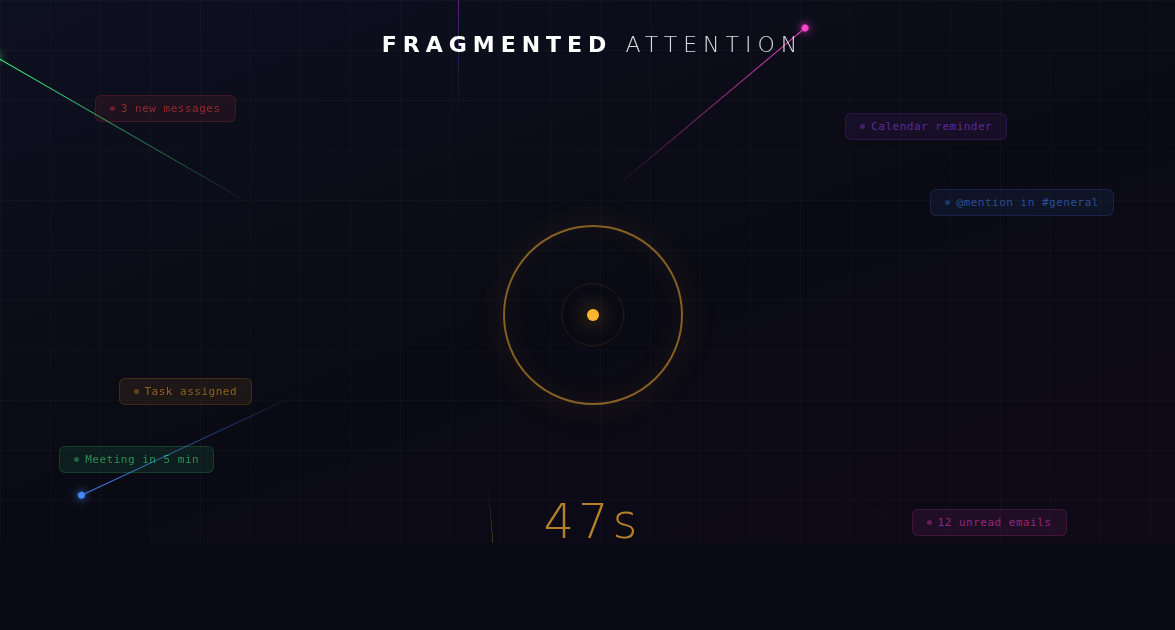
Here's a number that should bother you: 47 seconds.
That's how long the average person stays on a single screen before switching to something else, according to Dr. Gloria Mark's research at UC Irvine. Two decades ago, that number was around two and a half minutes. And it keeps dropping.
If that sounds abstract, consider what it means in practice. A team sits down to work. Within a minute, someone checks Slack. Another gets pulled into email. A third switches tabs. By the time they return to the original task, about 25 minutes have passed. Research consistently shows it takes that long to fully refocus after a single interruption.
Now multiply that across an eight-hour day, a team of ten, a full quarter. The cost is real. A 2025 report from Insightful found that 79% of US workers get distracted within an hour, and 59% can't go 30 minutes without losing focus. Organizations lose an estimated $588 billion annually due to attention-related productivity breakdowns.
This Isn't a Willpower Problem
The instinct is to blame individuals. People need more discipline. They need to stop checking their phones.
But research points elsewhere.
A 2024 study from MIT's Attention Lab found that continuous partial attention increased error rates by 37% and reduced working memory accuracy by 20%. Stanford research shows that heavy multitaskers perform worse than those working sequentially.
The brain is not built for constant task-switching. Neurologically, multitasking does not exist—only task-switching, and it is costly.
At the neurological level, this is called attentional fragmentation. The brain jumps between inputs without fully engaging. Over time, this alters activity in the prefrontal cortex, which governs decision-making and focus.
A 2025 study found that sustained attention breaks down in under two minutes of continuous switching.
The Tools Designed to Help Are Making It Worse
Slack, Teams, email, dashboards—these tools improve collaboration but create constant interruptions.
Research shows:
- +14% perceived stress
- -11% self-reported productivity
The average knowledge worker uses nine tools daily, each competing for attention.
Remote work adds another layer. Employees checking messages after hours experience higher fatigue the next day. The boundary between work and rest has blurred.
This connects to cognitive debt: outsourcing thinking to tools weakens independent cognitive function over time.
What the Numbers Say About Burnout
68% of employees reported burnout in the past year.
The issue isn't hours worked—it's how those hours are spent.
Constant interruption prevents recovery. Stress accumulates. The result is exhaustion without productivity.
Globally, disengagement costs about $9 trillion annually.
Designing for Attention Instead of Against It
Organizations that protect attention do things differently:
- Protected focus blocks
- Reduced notification defaults
- Built-in recovery time
- Measurement of real focus time
Attention is not a personality trait. It is a system outcome.
The Real Question
The issue isn't shrinking attention spans.
It's shrinking opportunities to focus.
The question is no longer: "Why can't my team focus?"
It's: "What environment am I asking them to focus in?"
The teams that succeed will not be the ones with the most tools—but the ones that protect real thinking.
References
Mark, G. (2023). Attention Span.
Insightful. (2025). Lost Focus Report.
Gallup. (2024). Global Workplace Report.
World Economic Forum. (2025). Future of Jobs.
Frontiers in Human Neuroscience. (2025).
Stanford Communication Lab. (2022).